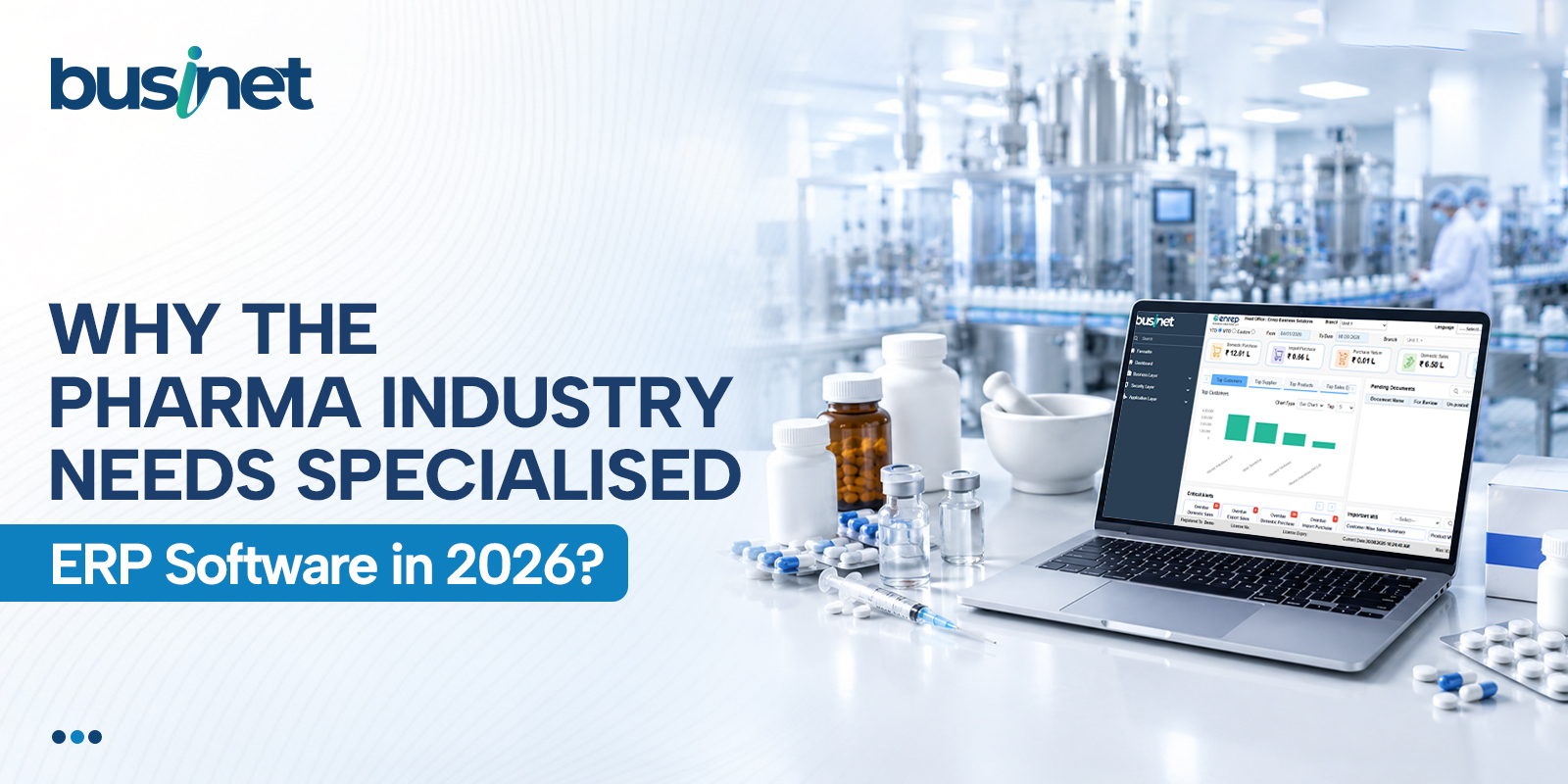
2026 marks a turning point for the pharmaceutical sector. Regulatory demands keep climbing, product lines keep growing wider, and profit margins keep getting thinner across both Indian and global markets.
Manufacturers, distributors, and innovators are all reaching the same conclusion: legacy systems can no longer carry the load. Adopting modern ERP software for pharma industry operations has moved from a nice-to-have to a business necessity.
Today’s ERP platforms are changing the way pharma companies handle compliance, manufacturing, distribution, and expansion. Combined with the right implementation partner, ERP stops being an expense and starts functioning as a driver of growth.
What is ERP Software for Pharmaceuticals?
ERP software for pharmaceuticals brings every major operational function of a life sciences company under one roof. Manufacturing, quality management, supply chain, procurement, finance, and regulatory compliance all run through the same system instead of sitting in separate tools. In a regular manufacturing setup, that’s mostly about efficiency. But inside a GxP-regulated pharma environment, the role expands. The system becomes part of how a company proves its compliance, because every batch record, e-signature, audit trail, and deviation log stored there can end up in front of a regulatory inspector.
This is exactly why pharma-specific ERP platforms are built differently from generic manufacturing ERP. They come equipped with:
- Validated deployment frameworks
- 21 CFR Part 11-compliant electronic records and signatures
- Batch and lot genealogy for full end-to-end traceability
- Recipe and formula management
- Stability testing workflows
- DSCSA serialisation support
Why Indian Pharma Companies Cannot Delay ERP Any Longer
India’s pharma sector has turned into a global heavyweight. The operational pressure on this industry has never been this intense, and here is what is driving it heading into 2026.
The Industry Has Outgrown Old Methods
India holds the 3rd spot worldwide for pharmaceutical production volume. It accounts for more than 20% of all generic medicines supplied globally. By 2026, the country counted over 2,000 WHO-GMP certified manufacturing units.
It also had more than 670 USFDA-approved facilities. That figure is the highest recorded outside the United States. The government’s PLI (Production Linked Incentive) scheme carries a total outlay of ₹15,000 crore through 2028-29. It is speeding up domestic API production and pulling in fresh investment. All of this is piling on more operational complexity for manufacturers.
Running operations at this scale calls for automation. It calls for traceability. It calls for real-time data. None of these can come from a spreadsheet or an outdated legacy system. This is precisely the gap that ERP for pharmaceutical companies is built to close.
Regulators Have Never Been This Strict
CDSCO, the country’s primary drug regulatory body, has ramped up enforcement noticeably. During 2025, 18% of inspected manufacturing sites failed to meet the newer data integrity standards.
Tighter sterility and data-integrity rules came into force in 2026. Facilities that fail to comply now risk shutdowns, regulatory penalties, and the loss of export licenses. Enforcement is expected to keep escalating through 2027. Documentation that is not audit-ready is simply not an option anymore.
GST and Fiscal Rules Keep Shifting
India’s GST system is far from static. Pharma companies now need IRN-linked e-invoices for every transaction. They need HSN-code-based journal entries. They need to file GST returns on time and generate e-Way bills for every interstate movement of goods.
As the government moves toward real-time tax reporting, handling this manually turns into a genuine risk. This is exactly where business automation software earns its place. A pharma ERP takes this off a finance team’s plate by automating fiscal compliance end-to-end.
Export Targets Require Digital Backbone
India’s pharma exports hit USD 30.38 billion in FY25. That represents a CAGR of 7% over the last ten years. Shipments now reach 191 countries. Half of that export volume flows into tightly regulated markets like the US and the EU. Selling into these markets means meeting FDA 21 CFR Part 11 and EU-GMP standards.
Those standards call for digital audit trails, electronic signatures, and fully validated systems. India also signed a Free Trade Agreement with New Zealand in 2026, opening zero-duty access for pharma exports. That deal brings new markets and a fresh set of compliance obligations along with it.
A generic ERP simply cannot keep up with all of this, but only a system built specifically for pharma can.
Generic ERP vs Businet Pharma ERP: Full Feature Comparison
Indian pharma companies frequently make the same costly mistake. They try to stretch a generic ERP, meant for retail or general manufacturing, over the demands of a highly regulated pharmaceutical business. It almost always ends the same way, with expensive rework, gaps in compliance, and failed audits.
Below is a side-by-side look at what a generic ERP offers compared to a Businet ERP system built specifically for pharma.
| Feature / Capability | Generic ERP | Businet Pharma ERP |
| Batch Manufacturing Records (BMR) | Not Available | Auto-generated, e-signed, version-controlled |
| Master Formula / Recipe Management | Basic BOM only | Version-controlled MFR with potency & yield tracking |
| Batch Traceability | Not Available | Bi-directional lot traceability end-to-end |
| Expiry Date & Shelf-Life Management | Basic expiry alerts only | FEFO logic, auto-blocking of expired/quarantined stock |
| Quality Control (QC) Workflows | Not Available | In-process testing, OOS/OOT investigation, COA generation |
| CAPA Management | Not Available | Structured deviation, non-conformance & CAPA workflows |
| CDSCO / Schedule M Compliance | Not Available | Built-in compliance templates and documentation |
| FDA 21 CFR Part 11 Audit Trail | Not Available | Unalterable, time-stamped audit trails |
| Electronic Signatures | Not Available | Role-based e-signatures at critical checkpoints |
| WHO-GMP Documentation | Not Available | SOP management, deviation tracking, validation records |
| Document Management System (DMS) | Basic document storage | Version-controlled approval workflow DMS |
| GST & E-Invoicing (India) | Varies by vendor | Native GST, IRN e-invoice, e-Way bill, TDS/TCS |
| Schedule H / Narcotic Drug Compliance | Not Available | Prescription tracking and statutory reports |
| Yield Calculation & Loss Tracking | Not Available | Actual vs expected yield analysis |
| Stability Testing Management | Not Available | Study scheduling and result logging |
| Equipment Calibration & Maintenance | Basic asset tracking | Calibration scheduling and GMP logs |
| Multi-Plant / Multi-Warehouse Operations | Limited support | Centralized control across all locations |
| PCD / C&F / Stockist Distribution | Not Available | Channel pricing, schemes, and credit limits |
| Regulatory Reporting | Not Available | Audit-ready compliance reports |
| System Validation (IQ/OQ/PQ) | Not Supported | Fully supported with documentation |
| Cold Chain Monitoring | Not Available | Temperature-sensitive tracking and alerts |
| Label & Packaging Compliance | Generic label printing | Drug-specific labelling and serialization |
Choosing the Right ERP Partner
An ERP built for pharma cannot treat compliance as an afterthought. It needs to be part of the system’s foundation from the start. Businet ERP is a web-based ERP designed for manufacturing and trading businesses across India.
It brings inventory, procurement, production planning, sales and distribution, sub-contracting, and finance together on one platform. GST, e-invoicing, and e-Way bill compliance come built in, not bolted on.
For pharma businesses ready to move past spreadsheets and disconnected tools, Businet ERP offers a genuinely connected way forward- the kind of ERP software for pharma industry teams can build on for years. Take a closer look at businet.in.
Frequently Asked Questions
1. How does ERP support compliance in the Pharma Industry?
It keeps data centralised. It enforces controlled workflows across manufacturing and quality operations and keeps a company ready for audits at any time.
2. Why is ERP critical for Pharma Industry manufacturing processes?
It gives manufacturers batch traceability. It supports accurate material planning. It offers the kind of production visibility a regulated pharma environment demands.
3. Can ERP help small companies in the Pharma Industry scale operations?
Absolutely. Modular ERP systems let smaller pharma businesses begin with the basics. They can add capabilities as production and distribution needs grow.
4. How does ERP improve decision-making in the Pharma Industry?
It delivers real-time analytics spanning finance, supply chain, and production. Decisions get made faster and with far more accuracy as a result.
5. Is cloud ERP safe for the Pharma Industry?
When set up correctly, today’s cloud ERP platforms fully satisfy the security, validation, and compliance standards the pharma industry requires. Businet ERP is built with these exact standards in mind.