Why Footwear Manufacturers Need Better Control Across SKUs, Production, Costing and Quality
Industry: Footwear Manufacturing
Solution: Businet ERP
Region: India
Table of Contents
The Ground Reality of Footwear Manufacturing
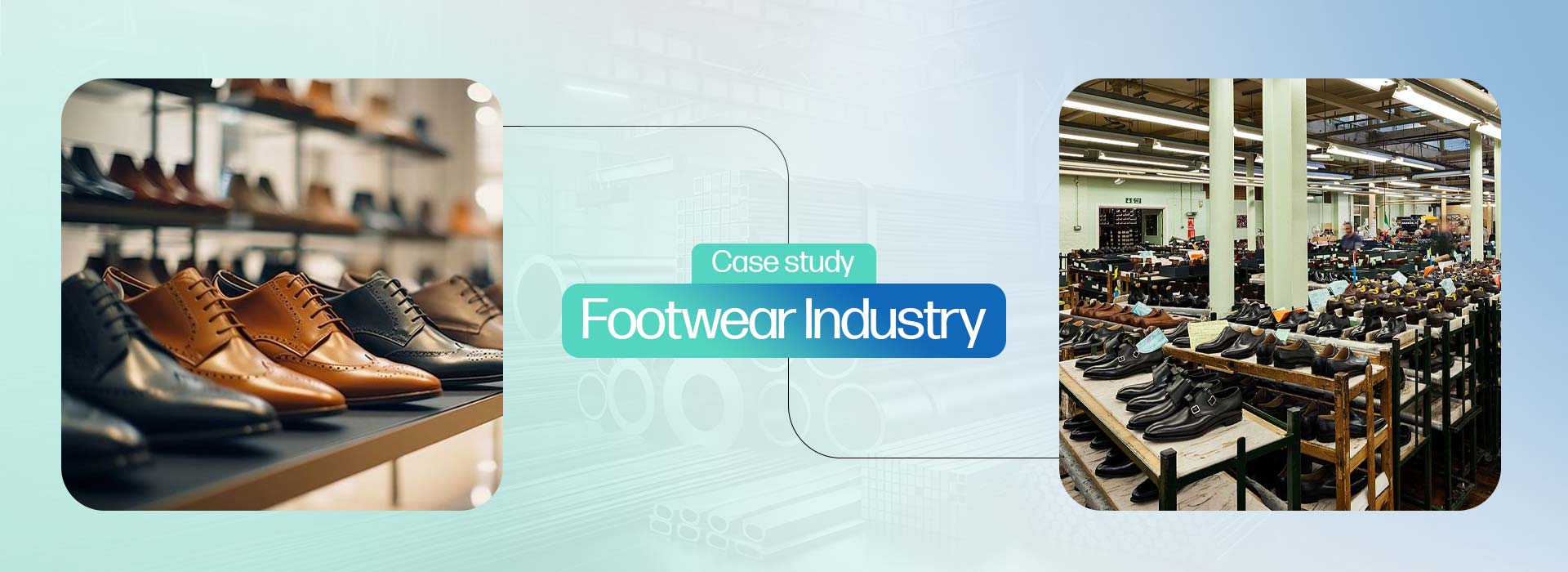
A footwear business can have hundreds of designs, and each design can come in several sizes, colours, patterns and packing formats. What looks like one product from the outside can actually mean dozens of different SKUs to manage internally.
This makes inventory control considerably more difficult. A particular size may sell quickly while another sits in the warehouse for months. One colour may need frequent replenishment while another barely moves. On top of that, goods may be purchased, produced and sold in different units or packing quantities.
Production brings another layer of complexity. Material requirements are planned through BOMs, but actual consumption can change during production. An alternate item may have to be used, material prices can move, and wastage can vary from one operation to another. If planned and actual figures are not compared properly, product costing and profitability can become difficult to establish.
Then there is rejection and wastage. Cutting, stitching, moulding, assembly, finishing, and other operations can each contribute to material loss or rejected output. Without recording these losses at the point where they happen, manufacturers are left trying to understand the problem after the fact.
This is where structured ERP Software for the footwear industry becomes important. Footwear manufacturers need a system that can connect SKU-level inventory, production, costing, sales and operational losses instead of managing each part separately.
The Challenge: What Actually Happens When These Problems Go Unresolved
- Hundreds of SKUs Make Stock Movement Difficult to Read
A single design may have multiple sizes, colours, patterns and packing configurations. Without proper FSN analysis, it becomes difficult to distinguish fast-moving products from slow-moving and non-moving stock.
- Multiple Packings and Conversions Create Inventory Gaps
Footwear may move through different packing quantities and units at different stages. When these conversions are handled manually, stock quantities can become difficult to reconcile across purchase, production and sales.
- Planned Costing Does Not Always Match Actual Consumption
The material planned in the BOM may not be exactly what gets consumed. Prices change, consumption varies, and alternate materials may be used during production. Without comparing planned and actual consumption, product costing can lose accuracy.
- Product Sales Do Not Always Tell the Full Profit Story
A product may generate strong sales while delivering a much smaller margin than expected. Without sales profitability analysis, manufacturers may not have a clear view of the actual profit generated by individual products.
- Wastage Can Occur at Different Production Stages
Material loss is not necessarily limited to one operation. Cutting, stitching, moulding, assembly or finishing may each produce different levels of wastage. If every stage is not recorded, identifying the source becomes difficult.
- Rejections Are Recorded Without Finding the Main Cause
Knowing the total number of rejected products is only the starting point. Manufacturers need to know which operation and which reason contribute most to the rejection rate.
- Recurring Losses Remain Hidden in Overall Production Numbers
When wastage and rejection are combined into broad figures, smaller recurring problems can go unnoticed. Over time, these losses increase production costs and put pressure on margins.
The Solution: What Businet ERP Brings to Footwear Operations
SKU-Level Inventory with FSN Analysis
Businet ERP for the footwear industry helps manufacturers manage large numbers of SKUs across different sizes, colours and patterns. FSN Analysis categorises stock based on movement, making it easier to identify fast-moving, slow-moving and non-moving goods.
This gives purchasing and inventory teams a clearer basis for deciding what needs replenishment and where stock may be unnecessarily blocked.
Packing and Unit Conversion Management
Different products can have different packing requirements. Businet production ERP software supports multiple units and conversions. These include purchase, production and sales, helping maintain consistent stock records even when products move through different packing formats.
Planned vs Actual Consumption
Businet’s BOM structure allows manufacturers to define planned material requirements and compare them with actual consumption. The Alternate Item on the business purchasing software feature provides flexibility when a planned material needs to be replaced with an approved alternative. This gives production teams a clearer picture of where consumption is moving away from the original plan.
Product Costing and Sales Profitability
Actual material consumption and procurement costs provide a stronger basis for calculating product cost. Businet procurement management software also provides Sales Profitability analysis, helping businesses see the margin generated from products after they are sold. Instead of looking only at sales value, management can examine whether individual products are actually contributing enough profit.
Wastage Tracking at Every Stage
Wastage can be captured against individual production stages and operations. Whether the loss occurs during cutting, stitching, moulding, assembly or finishing, the data can be recorded against the relevant process. This turns wastage from a general production number into something that can be investigated.
Wastage and Rejection Analysis with Pareto
Businet footwear manufacturing ERP software allows wastage and rejection to be captured against different production stages and operations. Once this information is recorded, manufacturers can analyse the data through Pareto Analysis to identify the reasons responsible for the largest share of wastage or rejection. This helps teams focus their improvement efforts where the losses are actually coming from.
The Operational Shift – Before and After Businet ERP
| Business Function | Before Businet | After Businet |
| SKU & Inventory Movement | Large numbers of sizes, colours and patterns make stock movement difficult to track. | FSN Analysis shows which SKUs are fast, slow or non-moving. |
| Packing & Conversions | Different packing quantities and units create reconciliation issues. | Multiple units and conversions are managed systematically across transactions. |
| Production Consumption | Planned material and actual consumption are difficult to compare. | BOM-based planning can be compared with actual usage, including alternate items. |
| Product Costing | Costing is often based on planned figures that may differ from actual production. | Actual consumption and procurement costs provide a clearer product cost. |
| Sales Profitability | Sales value is visible, but actual product-level profit is harder to establish. | Sales Profitability helps identify the actual margin generated by products. |
| Wastage | Losses across different operations are recorded broadly or manually. | Wastage can be captured against specific stages and operations. |
| Rejection Analysis | Total rejection may be known, but the main reasons remain unclear. | Rejection reasons can be analysed using Pareto to identify the biggest contributors. |
Results & Impact
With Businet ERP, footwear manufacturers can gain:
- Better control over large SKU volumes
- Clearer visibility into fast, slow and non-moving products
- More consistent stock management across packing formats and units
- Better comparison of planned and actual material consumption
- Greater accuracy in product costing
- Visibility into actual sales profitability
- Stage-wise tracking of wastage and rejection
- Clear identification of the biggest rejection and wastage contributors through Pareto Analysis
- Better information for purchasing, production and inventory decisions
The bigger change is visibility. Instead of seeing only how much was produced or sold, manufacturers can see what is moving, what it costs, where material is being lost and which problems are affecting profitability.
About Businet ERP
Businet is a web-based ERP platform built for Indian manufacturers and distributors. It brings production, inventory, procurement, sales and accounts together in one system.
For footwear manufacturers, Businet helps connect the details that are difficult to manage separately, from multiple SKUs and packing conversions to BOM-based consumption, alternate items, product costing, sales profitability and stage-wise wastage and rejection analysis. Businet footwear inventory management software FSN Analysis gives businesses a clearer view of inventory movement, while Pareto Analysis helps identify the rejection and wastage reasons that deserve immediate attention.
For growing footwear manufacturers, having this information in one place can make everyday production and inventory decisions easier to track, review and act on.
See How Businet ERP Can Help You Take Better Control of Your Footwear Business. Visit businet.in to request a demo.