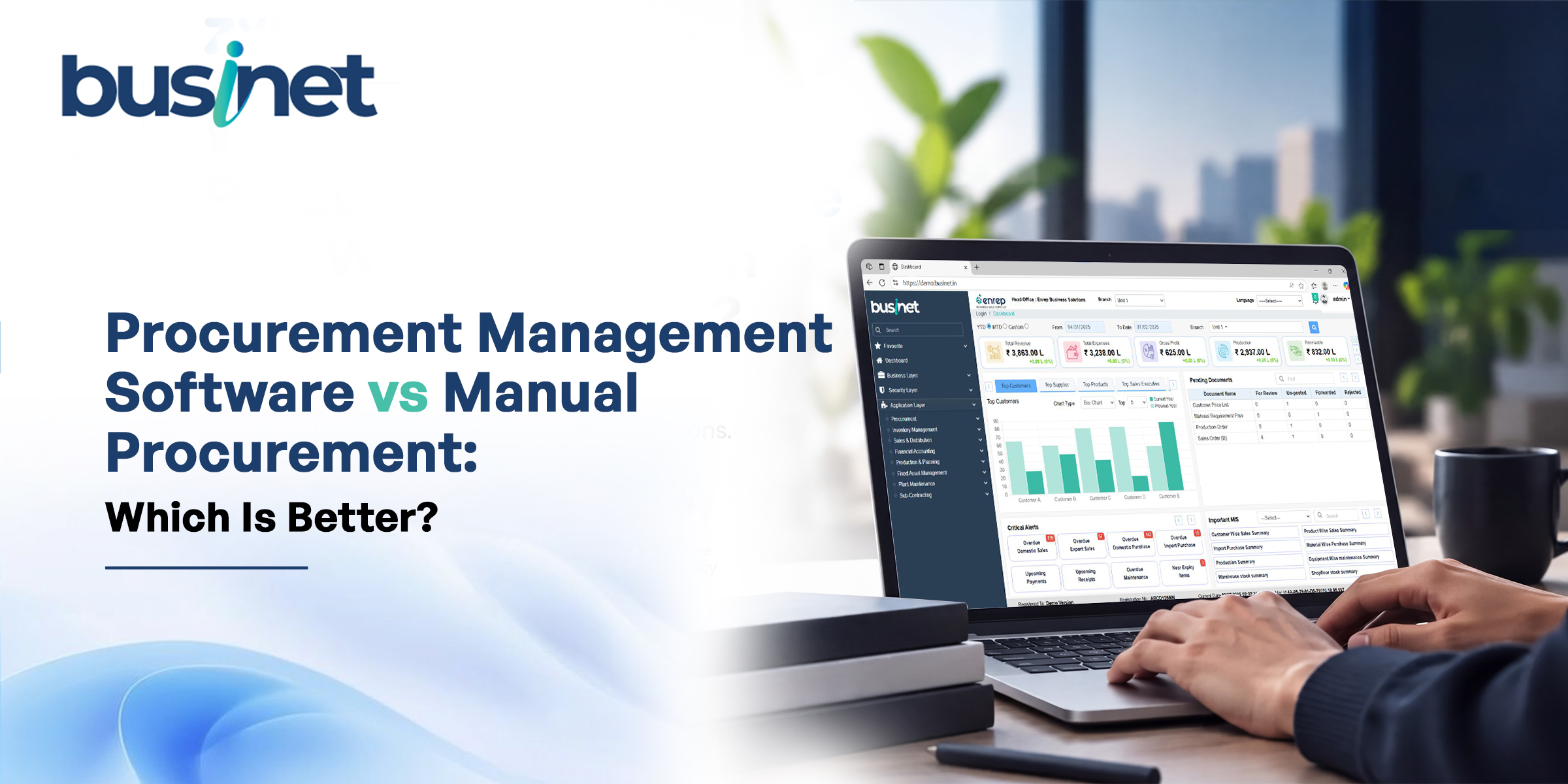
Procurement teams often lose valuable hours chasing quotations, checking purchase orders, following up with suppliers and matching invoices. A process that looks manageable on paper can become difficult when purchase volumes increase.
According to a Deloitte survey, 57% of procurement leaders said their organisations were increasing investment in digital procurement capabilities. That shift reflects a simple business reality: manual procurement becomes harder to control as a company grows.
For Indian manufacturing and trading businesses, the challenge is even broader. Procurement connects purchasing with inventory, production, accounts, suppliers and management approvals. One missing update can affect several departments. The real question is not whether manual procurement works. It is whether it continues to work efficiently when the business expands.
Understanding Manual Procurement
Manual procurement usually depends on spreadsheets, emails, printed documents, phone calls and individual follow-ups. A purchase executive may request quotations from three suppliers, compare prices in an Excel sheet, obtain approval through email and then prepare a purchase order separately.
This method can work for a small business with limited suppliers and fewer transactions. It also gives employees a familiar process that requires little initial training.
However, manual work depends heavily on people remembering every step. If a quotation remains in someone’s inbox or an approval gets delayed, the entire purchasing cycle can slow down.
Consider a manufacturing company that needs steel coils every month. Its purchase team may maintain supplier rates in separate spreadsheets. If the latest rate is not updated, the team could place an order using outdated information. The mistake may only become visible when the invoice arrives.
Understanding Digital Procurement
A digital procurement process brings purchasing activities into a connected system. Requests, quotations, approvals, purchase orders, receipts and invoices can follow a defined workflow.
Modern procurement platforms can also connect purchasing with inventory and finance. This gives managers a clearer view of what has been ordered, what has arrived and what still needs attention.
A connected system does more than reduce paperwork. It creates a structured record of procurement activity. Teams can review supplier performance, purchasing trends and approval histories without searching through multiple files.
| Operational Area | Manual Procurement | Digital Procurement |
| Purchase Order Management | Separate manual preparation; higher risk of quantity or pricing errors | Predefined approval routing; automated PO generation from requests |
| Supplier Information | Records scattered across Excel sheets, emails, and physical files | Centralised records showing purchase history, rates, and agreed terms |
| Approval Control | Delayed by email back-and-forth or physical desk sign-offs | Real-time automated notifications and mobile app approvals |
| Inventory Coordination | Manual cross-checking against disconnected stock spreadsheets | Live synchronization with actual inventory levels and open orders |
| Invoice & Payment Matching | Time-consuming physical comparison of POs, receipts, and invoices | Automated three-way matching with GST-compliant record tracking |
| Performance Tracking | Dependent on personal memory or anecdotal feedback | Systematic tracking of delivery timelines, pricing, and fulfillment |
| Reporting & Decisions | Slow, manual data collection prone to human error | Instant access to purchasing dashboards and drill-down MIS reports |
Key Differences Between Manual and Automated Procurement
The better option depends on the size, complexity and control requirements of the business. The following differences explain where each approach stands.
1. Purchase Order Management
Manual purchasing often requires employees to prepare purchase orders separately after receiving approval, and this creates opportunities for incorrect quantities, prices or supplier details.
With procurement management software, purchase requests can move through predefined approval levels before a purchase order is generated. For example, a raw material purchase above ₹5 lakh can be routed to a department head and then to senior management.
2. Supplier Information
Manual records can spread vendor information across Excel files, emails and accounting records. Employees may struggle to identify the latest quotation or agreed commercial terms.
A digital system keeps supplier details in one controlled location, and teams can review previous purchases, quotations, payment information and transaction history before placing a new order. For businesses managing dozens or hundreds of suppliers, this centralised approach can save considerable administrative effort.
3. Approval Control
Approval delays are common when requests move through email or physical files. Managers may not see a request until they return to their desk.
An automated workflow can notify the relevant person when an approval is pending. Mobile approval features are particularly useful for managers who travel between plants, branches and offices. This creates a more transparent process. Employees can see whether a request is pending, approved or rejected instead of repeatedly asking for updates.
4. Inventory Coordination
Procurement decisions should reflect actual stock levels. Manual procurement can make this difficult when inventory data sits in another system or spreadsheet.
An integrated ERP environment can connect purchasing with inventory. Suppose a distributor has 2,000 units in stock but another 3,000 units are already on order. The purchasing team can see both figures before raising another request, and this reduces unnecessary buying and supports better working-capital management.
5. Invoice and Payment Matching
Invoice verification can become time-consuming when purchase orders, goods receipts and invoices are stored separately. A connected system allows accounts and procurement teams to compare these records more efficiently. Differences in quantity, price or tax details can be identified before payment processing.
This is especially useful for Indian businesses that need to manage GST-related documentation alongside purchasing transactions.
6. Supplier Performance Tracking
Manual procurement makes supplier evaluation difficult. A company may know that a supplier frequently delivers late, but that information may remain based on individual experience.
With vendor management software, businesses can maintain a clearer transaction history and assess factors such as delivery timelines, order quantities, pricing and purchase frequency. For example, if Supplier A consistently delivers a critical component within four days while Supplier B takes ten days, management can use actual records when deciding future allocations.
7. Reporting and Decision-Making
Manual reports require employees to collect information from several sources. This takes time and increases the possibility of errors.
Digital procurement provides faster access to purchasing data. Managers can examine supplier spending, open orders, pending approvals and procurement trends from dashboards and detailed reports.
Research by McKinsey has found that companies using advanced analytics in procurement can achieve 5% to 10% savings in annual costs in suitable procurement categories. The result depends on implementation and business conditions, but it highlights the value of using purchasing data more effectively.
Why Growing Enterprises Need Integrated ERP Systems?
Deploying integrated ERP software connects procurement with inventory, sales, production and finance. For example, a manufacturing unit can raise a material requirement based on production planning. The request can then move for approval, supplier quotations can be compared, and a purchase order can be issued.
An integrated system also helps businesses:
- Link procurement with production, reducing raw material shortages.
- Track stock levels, helping teams purchase according to actual requirements.
- Compare supplier quotations, making purchasing decisions more informed.
- Manage approvals, ensuring purchases follow defined authorisation levels.
- Connect purchases with finance, making invoice and payment tracking easier.
- Monitor multiple locations, giving management a clearer view of procurement activity.
For growing enterprises, these connections can make a significant difference. Procurement affects production, cash flow and customer deliveries. With connected information, teams spend less time searching through spreadsheets and emails. They can focus more on controlling costs, managing suppliers and keeping operations moving.
Which Procurement Approach Is Better?
For very small businesses with simple purchasing needs, manual procurement remains practical. As transaction volumes and operational complexity increase, an automated approach becomes essential.
The strongest option is choosing a system that fits your approval structure, supplier network, inventory process, and financial controls. A web-based ERP provides centralised data, role-based access, multi-level workflows, real-time dashboards, and mobile approvals while keeping procurement connected to all other business functions.
Summing Up
Manual procurement may work when operations are small and predictable. But growth changes the equation. More suppliers, purchase orders and departments create more opportunities for delays, errors and missed information.
A structured digital procurement process gives businesses better visibility over purchases, approvals, suppliers, inventory and invoices. It also helps management access reliable information and make faster decisions.
The right time to improve procurement is before administrative issues start affecting production, cash flow or customer commitments. An integrated ERP can connect procurement with inventory, production, sales and finance, creating a smoother process across the business.
Ready to make procurement faster and easier to control? Explore Businet ERP software and see how our integrated modules can simplify purchasing, improve visibility and support your business as it grows. Book a product consultation and discover a smarter way to manage your operations.
Frequently Asked Questions
Is manual procurement suitable for small businesses?
Yes. Manual procurement can work for small businesses with limited suppliers and low purchase volumes. It becomes less practical as transactions, branches and approval requirements increase.
What are the main benefits of digital procurement?
The main benefits include faster approvals, centralised supplier records, better purchase tracking, improved reporting and stronger coordination between procurement, inventory and finance.
Can procurement software help reduce purchasing errors?
Yes. Defined workflows, controlled master data and integrated purchase records can reduce common errors involving quantities, prices, approvals and duplicate purchasing.
Is ERP useful for manufacturing procurement?
Yes. An integrated ERP can connect procurement with production planning and inventory. This helps manufacturers purchase materials according to operational requirements rather than relying only on separate spreadsheets.
Should a growing business completely stop using manual procurement?
Not necessarily. Businesses should first identify repetitive and high-risk activities that would benefit from automation. A phased approach can make implementation easier while keeping essential operations running.